Separating lining, heel-counter, toe-puff and reinforcement profiles beneath the upper
Shoe lining and support-part cutting dies
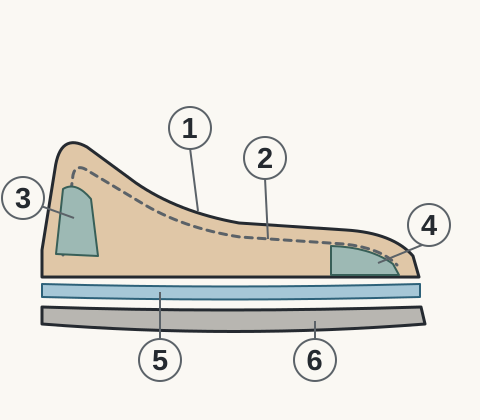
Internal footwear components may be hidden, but they do not perform the same cutting task as the upper. Linings, heel counters, toe puffs, collar pads and reinforcement layers may be cut from textile, felt, foam or flat thermoplastic sheet. This service covers cutting dies for flat internal and support components, not the visible leather upper or sole. Internationally these support-part tools are also referred to as clicker dies or clicking press knives.
Which internal and support components can receive a die?
The component family changes with the style. Lining covers the inside of the upper; the heel counter supports the rear; a toe puff supports the forepart; collar pads and narrow reinforcements serve contact and assembly areas. Every component has its own approved profile.
- Inner and outer quarter linings
- Tongue and collar linings
- Heel-counter components
- Toe-puff and forepart supports
- Collar pads, foam and narrow reinforcements
How does a flat support blank differ from a formed part?
The cutting die creates the starting profile from a flat sheet. A heel counter or toe puff may later receive heat, moisture or forming in another process. The cutting die is not a press mould that creates the finished three-dimensional shape.
- The flat starting geometry is cut
- Subsequent forming is out of scope
- Send material in its pre-cut condition
- State the layer and covering construction
- Forming allowance must be approved in the drawing
How are direction, pairing and notches controlled?
Textile weave, felt density, foam layer and thermoplastic-sheet face can influence placement. Right-left components, assembly notches and references matching the upper are shown separately on the drawing.
- Textile or material direction
- Inner-outer and left-right identification
- Stitching and assembly notches
- References matching the upper component
- Layer face and adhesive direction
What is required for a quote?
Because lining and support components are often hidden in the finished shoe, they cannot be recovered from a product photograph. Send a 1:1 drawing or sample for every component, the material construction, size range and references matching the upper.
- Component-level PDF, AI or DXF drawing
- Lining, heel-counter and toe-puff samples
- Actual pre-cut material and thickness
- Size range and left-right set
- Stitching, bonding and assembly references
Assembly references for heel counters and toe puffs
A heel counter supports the heel region; a toe puff supports the toe region. On the flat component drawing, identify its orientation inside the upper and its assembly references. Mark where the lower edge, side ends and notches meet the upper in the same model file.
Name the coated face according to its intended placement. Left-right identification and assembly references clarify where lining and support pieces belong in the set.
Frequently asked questions
1Do you form the heel counter or toe puff?
No. We make the cutting die for the flat starting blank; heat or press forming into a three-dimensional component is out of scope.
2Is a lining die the same as an upper die?
Usually not. Lining allowance, material and inner-outer geometry can differ from the visible upper.
3Can felt and foam support parts be assessed?
Flat-component cutting suitability is assessed from the actual material sample, thickness and layer construction.
4Can a heel-counter die be made from a shoe photograph?
No. Internal parts are not visible in a product photograph; an approved 1:1 drawing or physical flat sample is required.
Request a quote for your cutting die.
Get a WhatsApp quoteFree and non-binding. During business hours, we reply in 14 minutes on average.