
The same leather cutting die can cut cleanly in one workshop and leave uncut edges or blunt early in another. The difference is usually not in the die but in the press it is placed on and in the cutting pad beneath it. A manual arm press, a hydraulic press and a swing-head press give the same rule different conditions, which is why the die maker asks for the press used, the cutting area and the existing knife construction with the order. This article explains where the match between press and based cutting die is made; it contains no machine sales or model recommendations.
Leather clicker press types and the conditions the die meets
In small workshops the manual arm press is common: the operator places the die on the leather and pulls the lever, and the cutting force comes from the operator's movement. The cutting area is small, the force limited and the stroke speed variable. On this press a compact die and a sharp rule decide the cut.
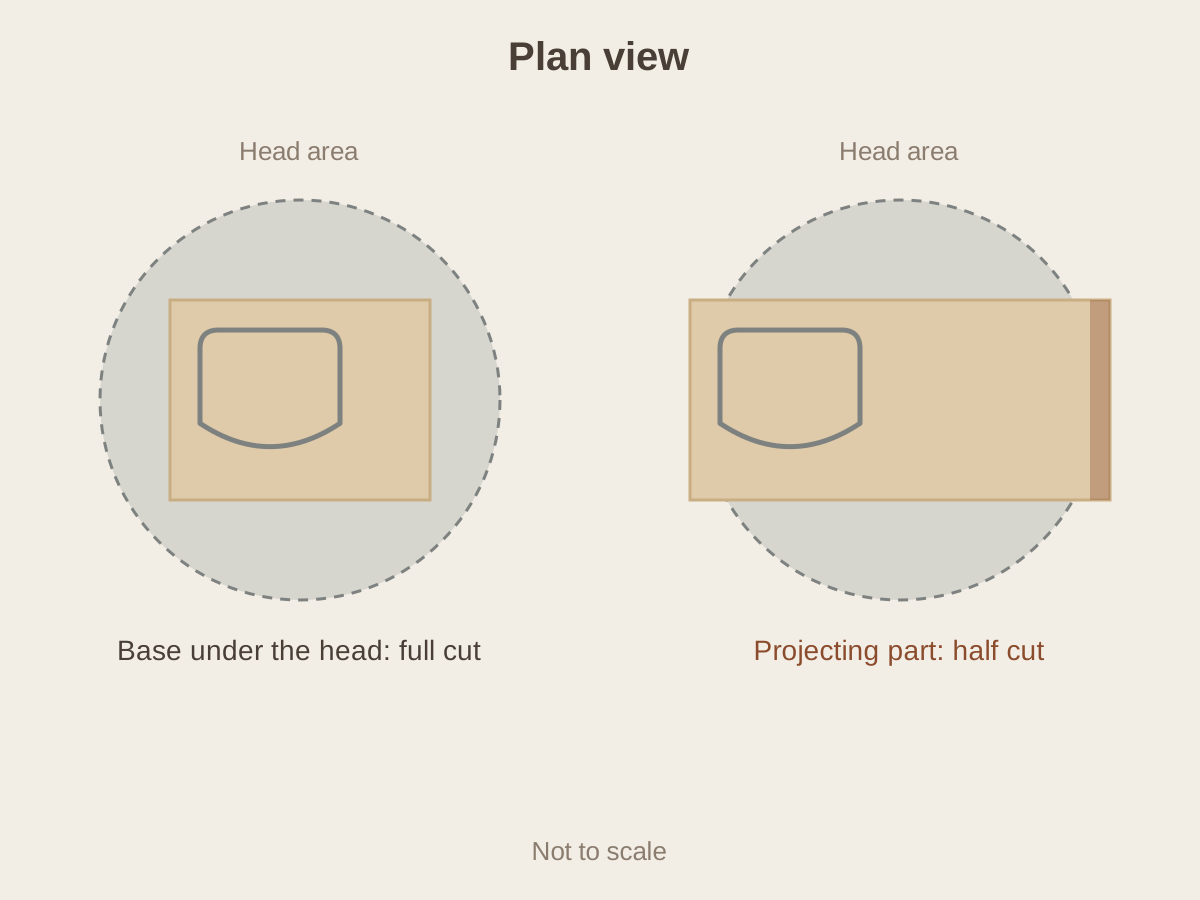
The hydraulic swing-head press is the construction most used in the leather and footwear sectors. The head swings sideways over the bed, the operator positions the die by hand on the chosen region of the hide and swings the head over it for the stroke. The force is constant, but the relationship between the head area and the die area is critical: any part of the rule outside the head receives no pressure.
Flat-bed hydraulic and beam presses cut larger tool sets in one stroke. Here the die base is fixed to the machine bed and the leather is laid over the die. Because the force spreads over a large area, the force per unit of rule length falls as the total rule length grows; tool design takes this into account.
| Press type | Decisive condition for the die |
|---|---|
| Manual arm press | Limited force; compact base and sharp edge |
| Hydraulic swing-head press | Head area; the die must sit fully under the head |
| Flat-bed hydraulic and beam press | Pressure balance against total rule length |
Cutting area and the size of the die base
On a swing-head press the head must cover the whole die. A section of rule projecting beyond the edge of the head receives too little pressure on the stroke, and the leather there is left uncut or half cut. The outer size of the die base is therefore kept smaller than the head; where a set of several pieces is needed, the pieces are divided over separate bases.
On a flat-bed press the limit is the machine bed. How the base is fixed to the bed and how the leather is laid over the die decide the base size and the spacing between rules. In jobs where the operator moves the die freely over the hide, the base is kept as small as possible so that the piece can be placed by quality zone.
The cutting area given with the order produces this decision: the head size or bed size decides how many pieces the die can carry at most and where the outer limit of the base lies.
Rule height, base thickness and press opening
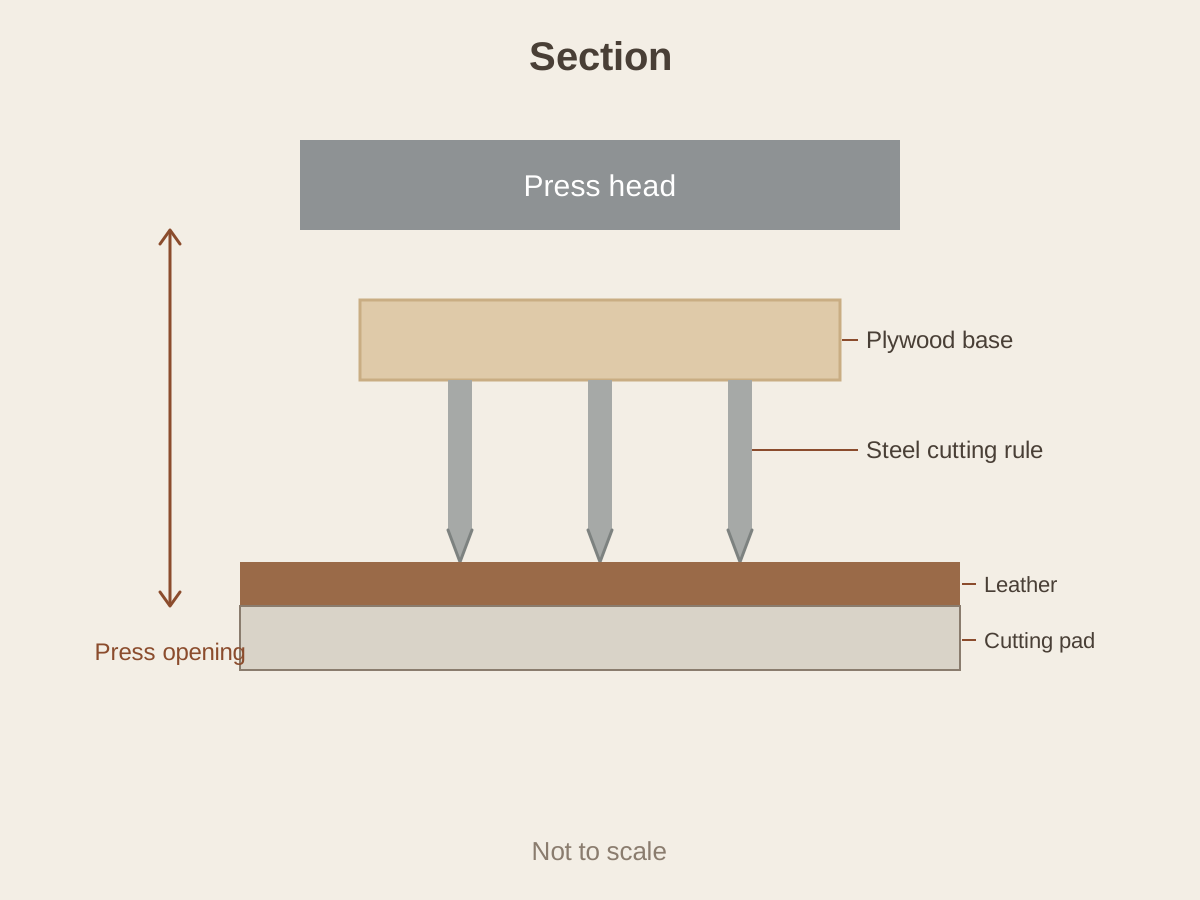
The total height of a based tool is the plywood thickness plus the rule height. In flatbed cutting the standard cutting rule height is 23.80 mm; with the common 18 mm plywood base, the total height of the tool is checked against the press opening. The gap between head and cutting pad must exceed that total plus the thickness of the leather.
A workshop used to welded press knives may have its press opening set for taller knives. When it moves to based tools, the stroke and opening are reset; otherwise the head reaches its stop before the stroke is complete, or travels too far and forces the rule into the pad.
This is why stating the existing knife construction with the order matters. If the die maker knows the height of the existing knives, the new tool is prepared so as not to disturb the press setting, or the required change of setting is announced in advance.
The cutting pad and protecting the rule edge
After the rule has cut through the leather, its edge meets a surface. If that surface is steel or a hard bed, the edge is crushed on every stroke and blunts quickly. Leather presses therefore carry a plastic cutting pad under the rule; the edge enters the pad slightly, the leather is cut fully and the edge is preserved.
The pad marks over time: repeated strokes in the same region open a groove in it, the rule runs into air there and the leather is not cut. Turning the pad regularly or planing its surface is the workshop's maintenance task; looking at the pad surface before suspecting the die explains most half-cut complaints.
With a based tool the rule edge faces not the plywood base but the pad under the leather. The die is used inverted, rule downwards; the base stays on top and the press head bears on the base. A flat, sound base lets the force spread evenly over the whole rule.
Pressure balance: small pieces, large sets and thick leather
Press force is divided over rule length. The rule of a single small strap piece is short, so it cuts easily under a given force; on the same press a wide body piece or a multi-piece set carries far more rule and the force per centimetre drops. A larger variant of a set that cuts comfortably on one press can therefore leave uncut fibres at the edge on the same press.
On materials such as thick sole leather, multi-layer synthetic leather or felt, the rule body carries more load, and point and edge are chosen accordingly. Raising the pressure does not solve every problem: excess pressure wears the pad and the rule edge early and crushes the edge of thin leather.
If the cut is incomplete, the first question is where it is incomplete. The same fault along the whole contour points to opening and pressure; a fault in one region only points to the pad surface and whether that region sits under the head. When this distinction reaches the die maker, the remedy is looked for in the right place.
| What is seen on the press | First point to check |
|---|---|
| Half cut along the whole contour | Press opening, pressure and rule height |
| Uncut fibres on one edge only | Groove in the cutting pad and head area |
| Piece does not release from the rule | Rubber hardness and height |
| Hole slug stays in the punch | Slug cavity inside the punch |
Natural leather, synthetic leather, textile and sole materials
Natural leather cuts with different firmness from one zone to another; an edge that comes out clean on the back may fray on the belly. The operator's decision on where to place the piece lies outside the die, but when the die maker chooses the rule edge and rubber from the real leather sample, the behaviour in different zones converges.
Synthetic leather and textile fray little but stretch a lot. On narrow pieces the material is pulled beside the rule and recovers after the cut, so the piece can look smaller than the drawing; comparison with the sample piece shows this deviation. On footwear sole stocks such as sole leather, resin board and EVA, thickness and hardness dominate; rules for these materials are handled separately in the shoe sole cutting die service.
Because upper, lining and sole pieces of one model are cut from different materials, different tools are used on the same press. Preparing each tool for its own material makes it easier for the press to cut every piece with one setting.
Which press details are given with the order?
The press brand alone does not describe the working conditions. The die maker needs: the press type (arm, hydraulic swing-head, flat-bed), the head or bed size, the opening between head and pad, the type and thickness of the cutting pad, the construction and height of the existing knives, and the material to be cut with its thickness.
When these details arrive with the piece drawings and the leather sample, the quotation describes the base size, rule height, point and rubber layout for the press in use. How the die is produced and at which stage each of these choices is made is covered in the guide on how leather cutting dies are made.
Press maintenance, safety arrangements and setting limits follow the machine manufacturer's instructions and the workshop's safety rules; the explanations here describe the relationship between die and press and do not replace machine setting instructions.


