
Thin waste strips left in cardboard divider slots add an extra stripping step. Pulling them out by hand can also tear the slot edges. The first check is whether the strip is still attached to the board or has been cut free but remains trapped between the rules. That distinction helps determine whether to examine the cutting line, the ejection rubber, or both.
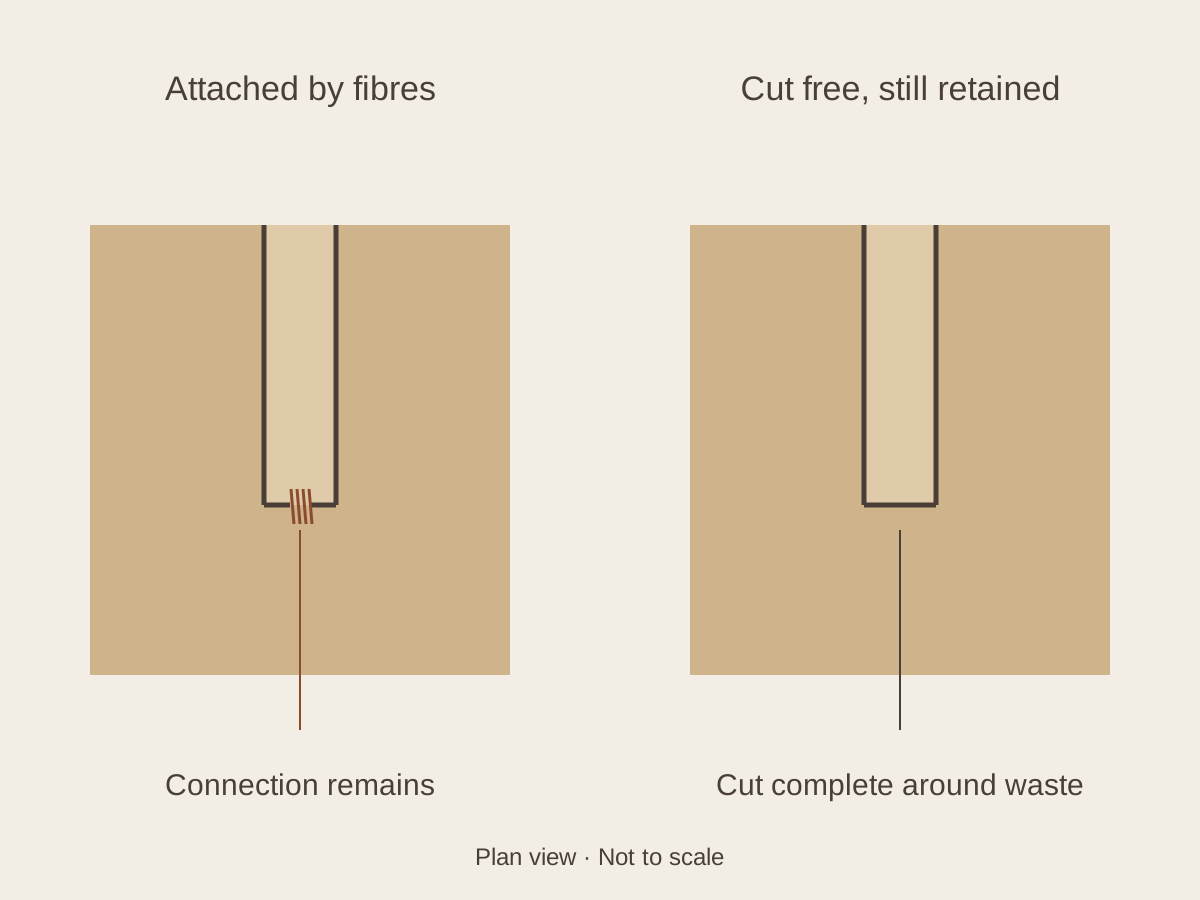
Has the waste been cut free?
Check the two long edges of the slot and its closed end separately. Fibres still joining the waste to the component point to an incomplete cut at that location. A strip with a fully cut perimeter may instead be held between the rules as the die opens. Both conditions can occur in one slot, so retained waste alone does not identify the cause.
The die maker matches the connection on the unstripped sample to the same position in the die. This shows whether it coincides with a rule joint, an intentional nick or another part of the cutting line. Pulling the waste out and tidying the edge beforehand can remove that evidence.
For example, a strip attached only at its lower end calls for a check of the end cut before changing the rubber. If all three edges are cut, the next question is whether the rubber can push the strip clear of the rules.
| After cutting | What to check |
|---|---|
| Waste attached by fibres at one point | The rule and any nick at that connection |
| Waste cut free but retained between rules | Rubber recovery and trapping inside the slot |
| The same slot repeatedly fails | Rules, joints and rubber at that location |
How ejection rubber works in a narrow slot
Ejection rubber compresses during the cutting stroke. As the die opens, it recovers and pushes the board away from the rules. There is little room for this movement between the parallel rules that form a divider slot. An arrangement used beside the outer contour may not work in that confined space.
Profile shape, hardness, height and position relative to the rules are selected together. Recovery after compression matters too. Dedicated profiles are available for narrow rule spacing in flatbed dies; the appropriate choice depends on the board and the tooling.
Rubber that is too soft for the application or has lost its resilience may not eject the waste sufficiently. With harder rubber, the sample also needs checking for crushing and pressure marks. Waste release and a clean component edge are assessed together.
Rule seating and cutting pressure
At an incomplete cut, check rule height, seating in the dieboard and rule joints. Die condition and the cutting counterface also affect the result. A broad area that fails to cut on one side of the sheet calls for a different investigation from a connection left only at the bottom of one slot.
More pressure may complete a local cut, but it also increases the load on areas already cutting correctly. The affected position should therefore be identified before adjusting pressure. If fully cut waste is trapped between the rules, first establish what prevents it from being released.
Does the same slot fail every time?
When a die contains several identical components, the affected position provides a useful comparison. If the others release cleanly, examine the rules and rubber around that particular slot. If the problem starts across the whole layout, material changes and press settings also need consideration.
Grammage alone cannot explain every problem that appears with a new batch of board. Actual thickness, flute construction and direction, and fibre separation can be compared with the previous sample. Different sheets can behave differently during cutting and ejection even when the drawing is unchanged.
Widening the slot also changes the divider fit
The slot receives another divider component. Widening it to release waste more easily can make the assembled partition loose. Any change to slot width is therefore a drawing revision, followed by another check of the interlocking fit.
For an existing die, examine the unstripped sheet, the removed waste and a drawing marking the affected slot together. Board and press details help establish whether the cutting line, rubber arrangement or machine setting needs attention.
These samples are also useful when ordering a new cutting die for cardboard dividers or corrugated partitions. A slot that repeatedly needs cleaning, or an edge that tears during stripping, can be considered during die preparation. The tooling brief then includes the production problem as well as the component drawing.


